

Your ServiceNow Backlog Is Not All SME Work
Three ways to buy federal ServiceNow development from NineFX, and where the delivery risk sits in each.
Demand for ServiceNow talent is high and market rates reflect it. The right blended labor mix brings the cost down, and firm-fixed-price delivery moves the risk off your program.
You hold the contract and owe the delivery. Below: what the three models are, what each costs you in risk, and how to add us to a team you have already won.
What we do
Certified developers, delivering on the platform today
Development across multiple ServiceNow modules for multiple federal customers, in both classified and unclassified enclaves.
1 of 3
Staff Aug
Qualified ServiceNow people in your labor categories, on the contract you already have.
Risk: Government and prime
2 of 3
In-House Team
Senior judgment where the work needs it. Right-sized labor everywhere else.
Risk: Government and prime
3 of 3
Fixed Price
A defined deliverable at a fixed price, with the delivery risk on us.
Risk: NineFX
NineFX employs developers who hold ServiceNow certifications, and we have developed across multiple ServiceNow modules for multiple federal customers, in both classified and unclassified enclaves. That work includes migrating existing on-premise, web-based solutions onto the platform and building new applications through both packaged and customized development.
If your agency already owns an instance, the hard question is rarely whether the work can be done - it is how to staff and price it without paying architect rates to close catalog tickets. Here are three ways to buy the work, and where the delivery risk sits in each.
1
Staff Augmentation
Qualified ServiceNow people in your labor categories, on the contract you already have.
Best when
The contract, the labor categories, and the technical direction are already fixed and the program needs seats filled now.
Sometimes the vehicle and the labor categories are already set, and the program needs qualified people in the seats. NineFX staffs ServiceNow roles as a traditional federal contractor, on our own vehicles or as a subcontractor under yours: we recruit against your LCAT descriptions and put developers who hold ServiceNow certifications to work under your program's technical direction. They follow your CMDB class model, your naming conventions, and your update set and change discipline rather than inventing their own.
The incentive to staff the work properly does not depend on the contract type.
Risk sits on the buying side here - this is a level-of-effort arrangement, so scope and schedule stay with the government, and with the prime when we staff under one. It is the simplest model to execute. It also inherits the rate structure of the contract it plugs into, which is why the next two models exist.
That is the contractual position rather than the whole picture. On cost-reimbursement work the government carries the cost of a slip - but the prime carries it too, because it owes the delivery whoever staffed it, and CPARS records the outcome for everyone on the contract. Our ratings follow us into every competition that comes after, so the incentive to staff the work properly does not depend on the contract type.
What it means
The fastest model to put in place, and the only one where nothing about your rate structure changes.
2
In-House Team, Mixed Experience Levels
Senior judgment where the work needs it. Right-sized labor everywhere else.
Best when
The backlog mixes hard architecture with routine configuration, the current rate structure prices both the same, and the requirement can be written to buy a team's output rather than a fixed set of labor categories. It also fits a prime that cannot fill development seats at its contract rates.
Federal ServiceNow labor category structures tend to push every developer into a subject matter expert slot. A real backlog is lopsided. A few items are genuinely hard - identification and reconciliation rules that keep the CMDB clean, a SAM Pro license model that will not map neatly to what procurement actually bought, an integration that has to keep working across upgrades. Most are not: catalog variables, Flow Designer approvals, ACLs, notifications, form layouts, reports.
A blend is the way back inside the rate structure.
NineFX composes the team to match. Senior engineers own the architecture and review what mid-level and junior developers build before it moves. The blend follows your backlog, not a rate card, and SME rates apply only to the work that actually requires an SME. Risk sits where it does in staff augmentation: this is still a team you direct, so the program carries scope and schedule. What changes is the rate structure, and who is standing behind the people.
Labor rates also move after award, and a team assembled from subcontractors is exposed to that in a way an in-house team is not. When the market moves away from the rates a subcontractor signed, the people stop appearing - the prime still owes the work, and the program still has the backlog. Our ServiceNow developers are NineFX employees, so the blend described here is one we can hold for the life of the contract. The size of that drift is documented: awarded ServiceNow rate cards on GSA schedule escalate a median of 3.2 percent a year and none faster than 4.8 percent, while GAO reported in April 2026 that on 106 of 389 Navy professional support task orders, actual labor rates had exceeded the estimates set at award by at least 15 percent.
This is also the answer when a prime cannot staff development at its contract rates. If the rate card assumes a labor mix the market no longer supplies at that price, every seat treated as a senior seat is a seat that stays empty. A blend is the way back inside the rate structure: senior engineers go where the backlog actually needs them, and the routine work goes to mid-level and junior developers who meet those labor categories on their own terms. The prime delivers against the rates it holds instead of reopening them, and the exposure that actually matters to a prime - not performing - comes down.
We can carry that blend because of where we are. NineFX is a HUBZone company headquartered in Columbia, South Carolina, and we hire into the zone. Salaries there track a cost of living well below the metros most federal development work is priced against, so mid-level and junior seats are viable at rates a prime can actually carry - and those developers are managed in-house, by the same senior engineers who review what they build.
What it means
You direct this team exactly as you would under staff augmentation. What changes is what you pay for the routine half of the backlog.
3
Firm-Fixed-Price Delivery
A defined deliverable at a fixed price, with the delivery risk on us.
Best when
The deliverable can be scoped and accepted on defined criteria, you would rather buy an outcome than hours, and you want to acquire it as a commercial service under FAR Part 12 - a defined deliverable is the specific outcome to be achieved that the definition describes.
Some ServiceNow work can be defined up front: a spoke, a scoped application, a migration of an on-premise, web-based solution onto the platform. NineFX will quote it firm-fixed-price. We have been delivering software to federal customers under FAR 12.212 for more than five years, so the commercial computer software terms that accompany a fixed-price software deliverable are familiar ground rather than a negotiation to be worked out mid-performance.
Your team reviews a product instead of monitoring a burn rate.
We agree on the deliverable and the acceptance criteria first, then carry the effort and schedule risk ourselves; if the build takes longer than we estimated, that is our cost, not an overrun on your program. This is risk transfer, not a discount - the requirement has to be defined well enough to price fairly, and we price the risk we accept.
Fixed price also pushes the design toward configuration over customization, because rework before acceptance comes out of our price. Your team reviews a product instead of monitoring a burn rate.
The same structure works after delivery. Maintenance of a scoped application - break-fix, platform upgrades, and the small enhancements that accumulate - can be bought firm-fixed-price for a period of performance rather than as a level-of-effort tail. It also puts the incentives where they belong: when we are paid a fixed amount to keep something working, every defect we prevent at build time is one we do not pay to fix later.
What it means
The only model where schedule risk leaves your program, which is why the requirement has to be defined well enough to price.
Defense software discipline, on the platform.
ServiceNow work is usually bought from platform shops. We build software for defense programs, and that practice comes with us - onto the platform, and into the enclave it has to run in.
- IL4 and IL5 environments
- We have delivered in IL4 and IL5 environments, including Microsoft 365 GCC High. The impact level decides what is actually buildable - which integrations exist at that level, what can cross a boundary, and what has to be built rather than connected - and that is cheaper to know at design time than at test.
- When the work is a binary, not a script
- Not all of it is JavaScript on the platform. A MID server runs inside your network, and work that reaches it means producing and supporting an actual binary on infrastructure you own. NSA and CISA now tell critical infrastructure operators to move code like that to memory-safe languages. We already deliver in Rust and other memory-safe, type-safe languages - a decision we made before your program rather than during it.
- A short dependency list, on purpose
- The platform's JavaScript ecosystem makes it easy to pull in one more library, one more store app, one more snippet off a forum. Each one runs inside your instance with your data behind it. We add dependencies deliberately, and we can say why every one of them is on the list.
- Supply chain risk, with an SBOM to show for it
- Third-party code is a C-SCRM problem before it is a convenience. Dependencies are pinned to versions and checked on the way in, and every delivery ships with a software bill of materials - what is in it, which version, where it came from - so a vulnerability disclosed next year is a question we answer in an afternoon rather than an investigation.
- Reviewed before it reaches your instance
- Every change is read by an engineer who did not write it. Update sets move code between instances; they do not review it.
- Pipelines that leave a record
- Builds, tests and security scans run on every change, and what shipped, when, and against which ticket is recorded. DevSecOps on the platform means the same evidence trail a defense program expects anywhere else.
Evidence
What a developer costs, by where they sit
Software developer wages in Columbia run about 20 percent below the Washington metro. That gap is what lets a blended team be staffed at rates a prime can carry - it is a cost-of-living difference, not a difference in what the work is worth.
- DC Metro
- $154,930
- United States
- $135,980
- Columbia, SC
- $123,380
At a glance
The three side by side
- You buy
- Hours in your LCATs
- Scope and schedule risk
- Government and prime
- Labor priced at
- Your contract's rates
- If market rates move
- Seats get harder to fill
- You review
- Staff performance
- Needs
- Set LCATs
- You buy
- A team's output
- Scope and schedule risk
- Government and prime
- Labor priced at
- Blended to the backlog
- If market rates move
- Carried in-house
- You review
- Delivered work
- Needs
- Output-based requirement
- You buy
- A deliverable or a maintenance period
- Scope and schedule risk
- NineFX
- Labor priced at
- Fixed, risk priced in
- If market rates move
- Priced in at award
- You review
- A product
- Needs
- Acceptance criteria
Contract-type shorthand. On cost-reimbursement work the government carries the cost of a slip, but the prime carries it too - it owes the delivery whoever staffed it, and CPARS records the outcome for everyone on the contract.
For the buying agency
- Get on contract sooner
- A HUBZone or SDVOSB set-aside narrows the field before the solicitation goes out, and both programs carry sole-source authority where the contracting officer's determinations and the current thresholds are met. What that saves is acquisition lead time - the months before anyone writes code - not delivery schedule.
- Proven delivery
- We have delivered commercial software on a firm-fixed-price basis as a prime: the contract type that puts cost and schedule risk on the contractor rather than the program. Past performance is available on request.
- Meet your goals
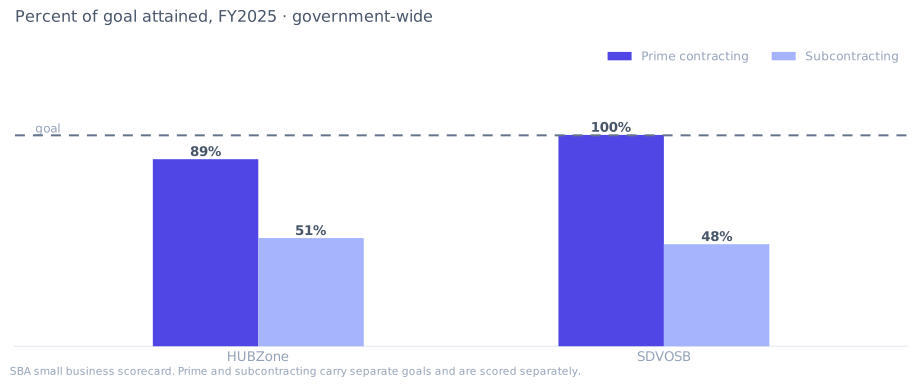
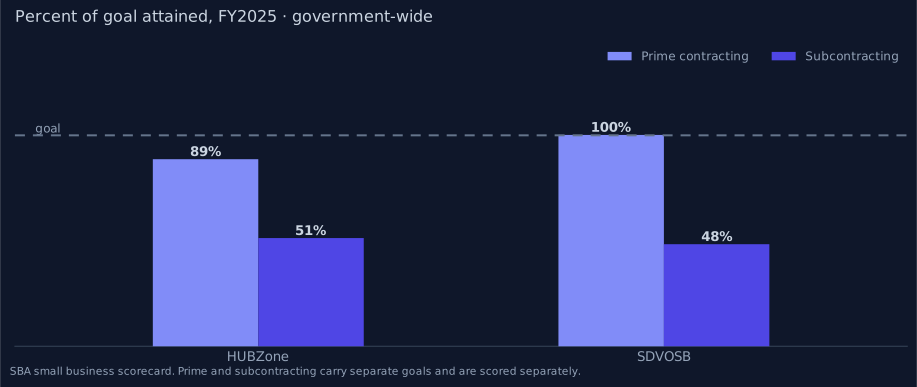
- The government-wide HUBZone goal has come in short every year - 2.66 percent against 3 percent in FY2025, after 2.75 percent in FY2024 - so the room to move it is real. The scorecard grades prime contracting and subcontracting as separate lines, each carrying its own goal and its own weight, so a defined piece carved out of a large IT contract and awarded direct moves the prime line rather than someone else's subcontracting one. It works best on the piece you are least comfortable with, because carving out the area that is hardest to staff is what puts a specialist on it.
Putting it on contract
NineFX is a HUBZone and SDVOSB small business, which gives a contracting officer more than one way to reach us without running a full open competition.
If you are a contracting officer
- Set-aside competition
- A requirement can be set aside for HUBZone concerns under FAR 19.13, for service-disabled veteran-owned concerns under FAR 19.14, or for small business under FAR 19.502-2. NineFX qualifies under all three.
- Sole source
- Both programs carry sole-source authority - FAR 19.1306 for HUBZone and FAR 19.1406 for SDVOSB - where the contracting officer's determinations and the current dollar thresholds are met.
- Through a joint venture
- Innovative Union holds GSA MAS and OASIS+ in small business, HUBZone, and SDVOSB tiers, which puts the same team on an existing governmentwide vehicle.
If you are a prime
- Added to a prime team after award
- A prime carrying a subcontracting plan under FAR 19.7 reports achievement against separate small business, veteran-owned, service-disabled veteran-owned, and HUBZone goals. NineFX credits all four lines at once, so bringing us onto the team mid-performance helps the plan rather than complicating it.
Talk through your backlog
Tell us what is in the queue and which vehicle you are working from, and we will tell you which of these three models fits - including when the answer is none of them.